What Continual Learning Actually Means - and What It Doesn’t
A first-principles clarification of continual learning as a runtime property: selective adaptation under consequence, distinct from retraining cycles, scale, or constant parameter drift.
Intelligence unfolds in time.
An organism does not encounter the world as a sequence of isolated questions. It moves through an environment where each action produces consequences that influence what happens next. The outcome of a previous interaction alters expectations, shapes behavior, and changes how the next situation is interpreted.
This continuity is fundamental. A creature that failed to carry forward the consequences of its experiences would be forced to rediscover the same lessons repeatedly. Learning would never accumulate.
In biological systems, experience modifies internal state. Memory forms. Expectations shift. Strategies improve. Over time, behavior reflects not just the current situation but the history that preceded it.
Artificial systems can be built in different ways. Some accumulate experience during operation. Others treat each interaction as an isolated event.
This difference is often described as the distinction between stateful and stateless systems.
Understanding what these terms mean-and why the distinction matters-helps clarify an important architectural question in artificial intelligence.
In simple terms, the distinction concerns whether a system carries information from one interaction into the next.
Many everyday technologies illustrate the difference.
A basic calculator is stateless. Entering “2 + 2” produces an answer, but the calculator does not remember having solved the problem before.
A navigation system in a car is stateful. As the vehicle moves, the system continuously updates its internal estimate of location and route progress. The next instruction depends on the path already traveled.
In computing, stateless architectures are often preferred because they are simple to scale and easy to manage. Each interaction can be handled independently, which allows systems to distribute requests across many machines.
Stateful systems are more complex. They must maintain continuity over time, ensuring that internal state remains consistent as new events occur.
Yet continuity is precisely what allows experience to accumulate.
Modern artificial intelligence systems often create the impression of being stateful.
Consider a conversation with a language model. A user might ask a question, follow up with clarifications, and refer back to earlier statements. The model responds coherently across the exchange, appearing to remember what has already been discussed.
This experience can feel similar to interacting with a system that maintains memory.
In practice, however, the architecture usually works differently.
In many large language model systems, the conversation history is simply included in the next input. The model processes the entire context again to generate a response. Nothing about the system’s underlying parameters changes as a result of the interaction.
Once the conversation ends, the system does not retain a memory of what occurred. If the same user returns later with the same question, the model does not recall the previous exchange.
The interaction feels continuous because the context is passed along temporarily, not because the system itself has changed.
From an architectural perspective, the system remains largely stateless.
The distinction becomes clearer when considering how language models acquire knowledge.
During training, a language model is exposed to large volumes of text and learns to predict the next token in a sequence given the preceding context. Through this process, the system adjusts millions or billions of internal parameters so that the probabilities it assigns to possible continuations better match the patterns present in the data.
Over time, the model learns rich statistical structures within language. These structures capture relationships between words, phrases, and ideas that allow the system to generate coherent responses across many different contexts.
Importantly, these parameters remain fixed during interaction.
When a user asks a question, the model generates a response using the probability structures learned during training. The model may appear to reason, explain, or discover new ideas during a conversation, yet the underlying parameters remain unchanged.
In this sense, modern language models can produce novel responses, but they do not accumulate experience from those responses. New knowledge is incorporated only when the model is trained again on additional data.
Learning and interaction therefore occur in separate phases.
The distinction becomes more significant when systems operate within environments that evolve over time.
Biological intelligence developed under such conditions. Ecological systems change continuously: food sources shift, competitors adapt, and environmental conditions fluctuate. An organism must adjust its behavior as these changes unfold.
Crucially, these adjustments occur during interaction with the environment itself. The organism’s internal state reflects the consequences of past actions, allowing it to refine behavior as circumstances evolve.
A system that could only update its knowledge during occasional training phases would struggle to keep pace with such changes.
Many artificial systems operate in relatively stable environments where this limitation is manageable. In other settings-financial markets, energy systems, logistics networks, or industrial processes-conditions may shift continuously.
Relationships between signals can drift, strategies may lose effectiveness, and new patterns can emerge unexpectedly.
In these contexts, the ability to incorporate experience directly during operation becomes increasingly important.
Statefulness provides one architectural mechanism for doing so.
A stateful system allows experience to leave a durable trace within the system’s internal structure.
Each interaction contributes to the system’s evolving state. Predictions, decisions, and interpretations are influenced not only by the current input but by the accumulated consequences of prior events.
This does not necessarily mean that the system must change its entire structure continuously. State can be represented in many ways: memory buffers, adaptive parameters, learned representations, or other forms of persistent internal information.
The key point is that the system’s behavior evolves as a direct result of its interaction with the environment.
Such architectures bring their own challenges. Continuous adaptation can introduce instability if feedback signals are noisy or misleading. Systems must manage the balance between retaining useful experience and avoiding drift.
These difficulties help explain why stateless designs remain common in modern machine learning systems.
Yet as artificial systems are deployed in increasingly dynamic environments, the architectural question of how systems maintain continuity over time becomes more relevant.
Discussions about artificial intelligence often emphasize scale: larger datasets, more parameters, or greater computational power.
These factors have undoubtedly contributed to recent progress. But architecture also shapes what systems can and cannot do.
The distinction between stateful and stateless systems highlights one such architectural choice: whether learning remains largely confined to training phases or continues during interaction with the world.
Stateless architectures excel at representing patterns learned from vast amounts of historical data. Stateful architectures enable systems to remain coupled to the consequences of their ongoing experience.
Both approaches offer advantages. The question is not which one will replace the other, but how future systems might balance stability with continuity.
Intelligence-biological or artificial-does not occur in isolated moments. It unfolds through sequences of interactions whose consequences accumulate over time.
Whether artificial systems will increasingly reflect that temporal continuity remains an open architectural question.
A first-principles clarification of continual learning as a runtime property: selective adaptation under consequence, distinct from retraining cycles, scale, or constant parameter drift.

An intelligent system shouldn't necessarily require static, pre-programmed knowledge to solve novel future problems.
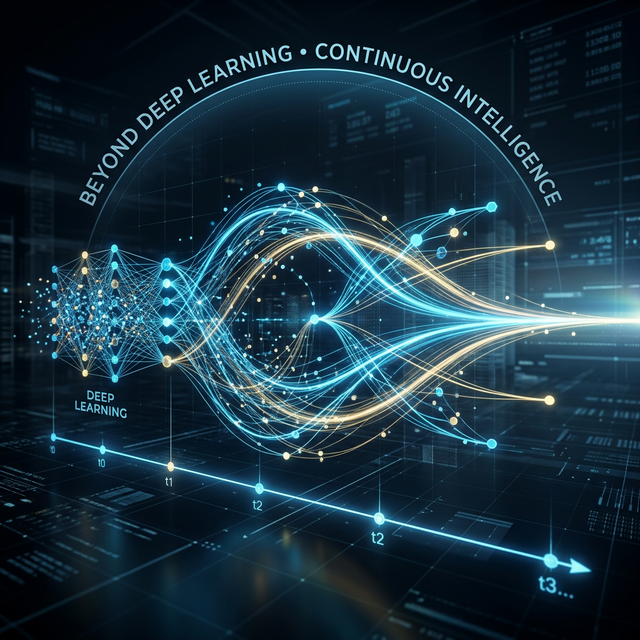
Intelligence is a process embedded in time: prediction under consequence. We explore why more general forms of artificial intelligence will likely require architectural properties that couple learning directly to ongoing interaction with changing environments.
We are currently engaging with investors and strategic partners interested in long-term technological impact grounded in scientific discipline.
Elysium Intellect represents a fundamentally different approach to artificial intelligence, prioritising continuous adaptation, reduced compute dependence, and real industrial application.
Conversations focus on collaboration, evidence building, and shared ambition.
Start a conversation